From Offending To Reoffending.
Families of offenders pay the price when it's not their crime.


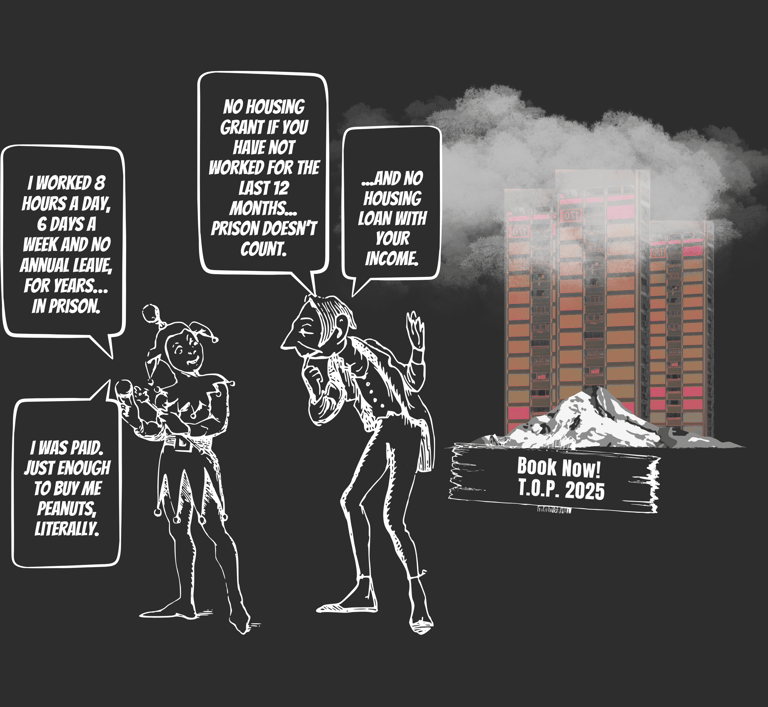
Relationships are impaired yet offenders rely on the kin for lodging. Living in such conditions breed the conditions of return to drug use.
Emotional losses
Financial Dissolution
Excess workload
They experience family upheavals, forced separation, and broken ties. For children, loss of parents / caregivers results in abandonment trauma, disrupting normal development.
The loss of a contributing family member to police remand or a prison term disturbs the distribution of duties in the household, carry serious implications for the family.
Fulfilling prison obligations add onto the workload.
Criminal defence expenditure, loss of income when in prison, receiving a low pay grade that normally accompanies a criminal record, are some ways that can lead a family to financial dissolution.
To be continued...
Are offenders reoffenders recalcitrant and hold the law in contempt?
To understand reoffending,
Offenders and their families face overwhelming odds against the criminal justice system.
Family members often suffer in silence, for fear of disclosing their familial ties with an offender
Exorbitant criminal defence fees, exponentially higher for trials, can be financially crippling.
Families of offenders pay the price when it's not their crime.
A series of paradoxes
Families of offenders are shocked by the jarring event. The mental and emotional turmoil persist over a long period of time with considerable challenges to overcome.
Children suffer disrupted attachment when parents / caregivers are taken from them. Younger children are particularly vulnerable.
To add on, change of caregivers, possible housing displacement and in some cases, separation from co-borns is highly destabilising.
This is a form of abandonment trauma and has serious long term negative repercussions, including substance abuse which gets them involved with the criminal justice system.
Family members are in line for a series of shocks that begin with the police arrest. With parents
Criminal conviction leads to career dissolution and void of academic achievements, eroding past efforts and affect state of finances.
Police arrest and lock up.
Impacts family members who suffer financial lack including unmet needs.
Often, they are sought out to contribute to the legal fees which affects their financial state.
Imprisonment causes forced separation and broken attachment.
Loss of work and income affects financial state.
Cessation of household duties and responsibilities. Long periods of idleness and boredom.
Loss of freedom in almost all aspects results in reliance on family members to provide (because the prison system does not), which includes visitation and communication.
Families face loss of income contribution, further straining their finances.
Disruption in distribution and fulfilment of household duties. Family members take on duties of their incarcerated kin, including obtaining a source of income. The increase in burdens compromise their own duties which could be important academic and work responsibilities.
Minimal help options available. Financial aid is challenging to get and even if approved, amount is meagre. Their cluelessness causes retraumatisation.
Post release,
Traumatised, requires time to reintegrate into society and depends on family for support.
Cessation of contribution to household duties and responsibilities.
Prolonged separation to family members cause broken attachment.
Traumatised family members have to uplift ex-offender kin when they are in crisis too.
Family members fulfil requests, again piling onto their own duties,
Prison visitation occurs twice a month. For certain clusters, they are fixed on weekdays office hours, clashing with working and studying family members.
Family members rush to meet timing, predisposing them to accidents along the way. They face increase in transportation cost due to need for hired vehicles, which is concerning due to their financial state.
Financial Losses
Psycho-emotional Wear Down
Remand cause forced and extended separation.
Pre-Conviction
Sentence Ongoing.
Children with parents / caregivers in prison will encounter the debilitating effects mentioned at the remand stage.
Prison visitation is not just crucial for the kin's wellbeing but a show of family support that preferences them for the offender's early release.
Children with parents / caregivers in remand and prison suffer disrupted attachments that have lifelong negative impacts.
With greatly restricted communication between inmates and family members, achieving family cohesion is a struggle.
Marital relationships are strained, leaving the spouse of the offender feeling unsupported, left to managing the family on his/her own.
Much harm is done when children have their parents imprisoned, even worse when they are the main caregivers. They experience abandonment trauma with serious lifelong consequences.
Families of offenders suffer from financial lack that grows as time progresses.
They assume more financial responsibility for the family's needs such as paying legal fees for the offender and acquiring an income. This goes on indefinitely.
However, financially sustaining the family is greatly undermined when fulfilling the obligations pertaining to inmate's wellbeing and the increased burdens with the major load of responsibilities resting on them.
Yet support for these families is abysmal. Hardly are programs implemented to address the needs of these families. In fact welfare agencies are almost scared to lend a hand.
The lack of resources and understanding regarding the unique needs of these families often exacerbate their situation, leading to feelings of isolation and helplessness.
There are 3 stages in the trajectory of an offender. All 3 stages deplete the offender financially; criminal defence expenditure in the pre-trial stage, loss of income in the imprisonment stage and stagnant, low income in the post-release stage.